
Breaking news: Beware the 24/7 news cycle – it could be bad for your wealth


With ongoing global unrest, political spats, and economic woes, it’s tough to stay informed without feeling overwhelmed.
24/7 newsfeeds expose us to more information than any other generation in human history. This could not only harm your mental wellbeing but also threaten your long-term financial security.
Scary news headlines get clicks
As every journalist knows, the secret to a successful story is the scare factor.
Financial journalists make the most of our susceptibility to fear. If markets decline and there’s even a hint of uncertainty, it’s an opportunity not to be missed.
Headlines are often carefully crafted to spark fear and are designed to alarm readers, making it doubly hard not to react to bad news.
The good news is that putting the facts into context and looking at the bigger (long-term) picture could make all the difference.
3 truths financial journalists don’t want you to remember
1. Steep market fluctuations are natural and happen more often than you may think
When you’re invested, it can be unnerving to watch markets fall. And yet, it’s natural for markets to fluctuate.
In fact, data from Schroders reveals that between 1971 and 2023, the MSCI World Index fell by 10% or more 30 times during the 52-year period. Falls of 20% or more occurred in 13 of the 52 years. [1]
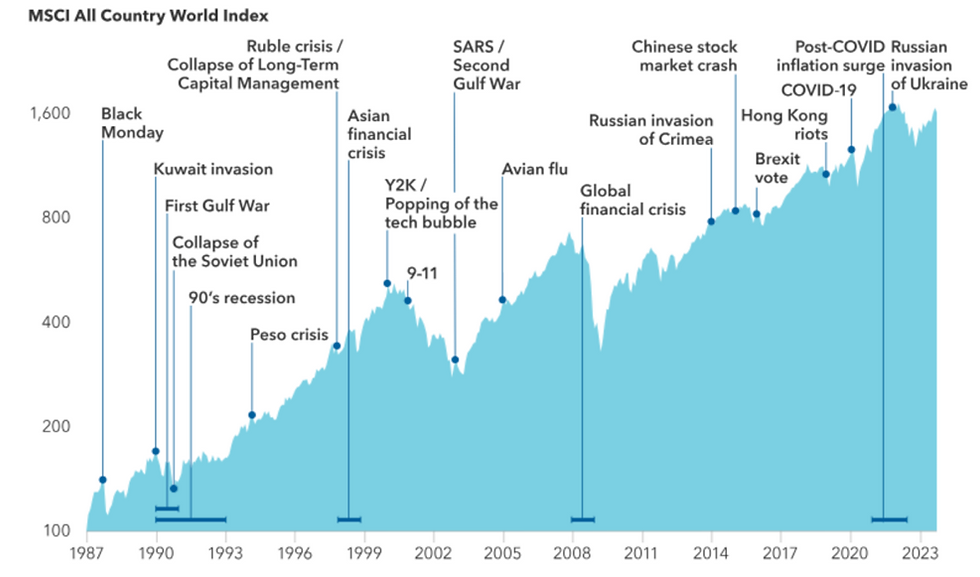
Despite regular dips, the MSCI World Index and other markets have enjoyed consistent long-term growth.
The chart below illustrates the growth of the MSCI All Country World Index alongside numerous major global events that caused significant market disruption between 1987 and 2023.
Source: TopForeignStocks.com [2]
2. Selling your shares makes a “paper loss” real
When markets are volatile, any drop in value is only a paper loss. It only becomes a real loss if you sell.
Holding your nerve and remaining invested may feel uncomfortable at the time, but history shows that staying in the market is the quickest route to recovery.
As legendary investor Charlie Munger of Berkshire Hathaway famously said, “The big money is not in the buying and the selling, but in the waiting.”
Looking again to data shared by Schroders, an investor who moved to cash during the 2008 financial crisis, following the first 25% of losses, would still be making up lost ground today. Meanwhile, those who remained invested would have seen their portfolios recover by 2013. [3]
3. Time in the market beats timing the market
Trying to time the market is a risky strategy – especially as data shows that the best days in the market tend to follow immediately after the worst.
According to a CNBC report, between 1 January 2003 and 30 December 2022, 7 of the 10 best days happened within two weeks of the worst 10 days. And the second-worst day of 2020 (2 March) was immediately followed by the second-best day of the year. [4]
A picture speaks a thousand words, and the one below shows how a $10,000 investment in the S&P 500 would have fared between 1 January 2003 and 30 December 2022 and the detrimental effects of missing the market’s best days.

Source: CNBC and JP Morgan [4]
Attempting to time the market could prove devastating for your portfolio. So much so that even professional fund managers avoid doing it. In fact, when they have a large sum to invest, they’ll typically drip-feed it into the market, rather than investing in one “bulk buy”.
Helpful reminders to keep front of mind when crises hit the headlines
A declining stock market could prove good news for regular investors. When markets decline, you’ll be buying cheaper units, and as you’ve seen above, these periods don’t tend to last for long.
Think long term. Don’t allow your 20-plus-year investment horizon to be derailed by the latest news bulletin.
Your portfolio is designed to weather market volatility. The winning strategy is to stay the course, remain invested, and let time do its work.
If you’re struggling to avoid getting caught up in the endless media noise, please get in touch. I’m here to provide a calm voice of reason and help you understand the bigger picture.
Email rory@brazilfinancial.ie or call + 353 86 824 7542.
Please note
This article is for information only. It is not investment advice. It describes financial planning services that Brazil Financial Planning can offer to you. Financial planning services are not regulated by the Central Bank of Ireland.
Brazil Financial Planning Ltd T/A Brazil Financial is regulated by the Central Bank of Ireland. Registered No. 477512.
The value of your investments (and any income from them) can go down as well as up and you may not get back the full amount you invested. Past performance is not a reliable indicator of future performance.
Investments should be considered over the longer term and should fit in with your overall attitude to risk and financial circumstances.
[1] Schroders, The data which can help you keep a cool investing head in a crisis
[2] TopForeignStocks.com, Growth of MSCI All Country World Index Thru Market Crises from 1987 to 2023
[3] Schroders, The data which can help you keep a cool investing head in a crisis
[4] CNBC, Now is the time to ‘think long term’ when investing, advisor says. This chart helps explain why


Comments